![Structural Damage & Car Write-Offs in South Africa: Code 3 Explained [2026]](/images/blog-chassis-structural-repair-cost.webp)
When a car takes a serious knock, the question that actually matters is not what the repair costs — it is whether the repair costs more than the car is worth. In South Africa there is no industry-wide write-off threshold: the insurance industry body has confirmed that individual insurers apply their own criteria.[1] As a rough guide, repairs running past 60–70% of a vehicle's value usually trigger a write-off,[2] though at least one major insurer says it deliberately does not use a fixed percentage at all.[3]
Get that call wrong and the consequences follow the car forever. A vehicle coded 3 keeps only 50–70% of its market value, and the code never comes off.[4]
Key Takeaways
- No single SA write-off threshold exists — SAIA confirms each insurer sets its own
- Rule of thumb: repairs above 60–70% of the car's value usually mean a write-off
- Code 3 is permanent and costs the car 30–50% of its market value
- Crumple zones are engineered to deform once — damaged structure is replaced, not beaten straight
- Cars written off as "Code 2 uneconomical to repair" do not appear on the free public database
- After structural work, ADAS cameras and radar need recalibration or they may read the road wrongly
What Counts as Structural Damage
Panel damage and structural damage are different problems with different consequences. A dented door, a scuffed bumper or a creased wing is cosmetic: the part is repaired or replaced and the car is exactly as safe as it was before. Our Centurion panel beating cost guide covers that kind of work.
Structural damage means the load-bearing skeleton of the car has moved or deformed. On a modern unibody vehicle that includes:
- Chassis rails — the longitudinal members running front and rear that absorb impact energy
- Sills and rocker panels — the beams under the doors that resist side impact
- A, B and C pillars — the roof supports that keep the cabin intact in a rollover
- Firewall and bulkhead — the barrier between engine bay and cabin
- Strut towers and suspension mounting points — where wheel loads feed into the body
- Floor pan and boot floor — structural panels, not just surfaces
The tell-tale signs are rarely dramatic. Doors that no longer close cleanly, uneven panel gaps, a car that tracks to one side or eats tyres unevenly after an accident, or a boot lid that suddenly needs a shove — these point to a shell that is no longer square. Any of them warrant measuring rather than guessing.
Why Crumple Zones Are Replaced, Not Straightened
This is the part owners most often misunderstand, and it drives a lot of the cost.
The crumpled front end of a modern car is not a failure of the car. It is the car working exactly as designed. Crumple zones are engineered to collapse in a controlled way, absorbing crash energy over distance so that less of it reaches the people inside. The deformation you are looking at is energy that did not go into the cabin.
The consequence is that a crumple zone is a single-use safety device. Once a structural member has folded, the steel has been permanently deformed and work-hardened, and it will not behave the same way in a second impact. Modern vehicle structures also mix steel grades deliberately — ultra-high-strength steel in the cabin's safety cage to resist intrusion, softer grades ahead of it designed to fold. Straightening a member back to roughly the right shape does not restore the metallurgy that made it work.
That is why proper structural repair replaces or sections damaged members to the manufacturer's specification rather than simply pulling them straight and calling it done. It costs more up front. It is also the difference between a car that protects you in the next accident and one that only looks like it will.
What Chassis Straightening Actually Involves
Where structure has moved but is not destroyed, straightening is legitimate and precise work. It is not a matter of pulling until it looks right.
- Measuring first. The car is measured against the manufacturer's dimensional data using an electronic or mechanical measuring system, establishing exactly how far each reference point has moved and in which direction.
- Anchoring. The vehicle is clamped to a straightening bench at the sills so that pulling force acts on the deformed area rather than dragging the whole shell.
- Controlled pulling. Hydraulic towers apply force along calculated vectors, often in stages and in more than one direction at once, releasing the damage in roughly the reverse order it occurred.
- Re-measuring throughout. The measuring system stays live during pulling so the technician works to numbers, not to eye.
- Replacing what cannot be pulled. Members too deformed or work-hardened to recover are cut out and replaced with new sections, joined by the method the manufacturer specifies.
The equipment is specialised — bench systems and measuring equipment from manufacturers such as Car-O-Liner and JOSAM are distributed in South Africa — and a workshop without it cannot verify that a shell is straight, only that it looks straight. That distinction is the whole ballgame on a structural job.
What Structural Repair Costs
Here is the honest answer: nobody in South Africa publishes a price list for structural repair, and any figure quoted without seeing the car is guesswork. That is not evasion — it reflects how the work is priced. Two cars with identical-looking front-end damage can differ by tens of thousands of rand depending on whether a chassis rail moved 5mm or 50mm, and whether the airbags fired.
What we can tell you is what actually drives the number:
- How far the structure moved. Millimetres of movement that can be pulled back is a different job to a folded rail that must be sectioned and replaced.
- Whether the safety systems deployed. Airbags, pretensioners and their control modules are among the most expensive single items on a collision repair, and they are replacement-only.
- Parts availability and origin. Genuine structural parts for imported and premium models carry a substantial premium, and lead times on back-ordered structural panels frequently outlast the repair itself.
- Labour hours and rate. Structural work is measured in days on a bench, and published South African labour rates vary several-fold between workshops.
- Calibration and verification. Post-repair ADAS recalibration and safety-system checks are a real line item on any modern vehicle, discussed below.
Because structural work runs into days rather than hours, it is also the category most likely to leave you without a car for a while — our guide to realistic panel beating timelines sets out what to expect.
The practical move is to get the damage measured and quoted properly, then compare that quote against what the car is actually worth — because that ratio, not the rand figure on its own, decides what happens next.
When an Insurer Writes a Car Off
A write-off — or "total loss" — is an economic decision, not an engineering one. The insurer is deciding whether repairing the car costs more than settling it.
The figure most often quoted in South Africa is that repairs exceeding 60–70% of the vehicle's insured or market value will usually see it declared a write-off.[2] Treat that as a rule of thumb rather than a rule. The South African Insurance Association has stated plainly that vehicles are written off where repair costs exceed "different thresholds, relative to the current value of each vehicle, applied by individual insurers", and that there is "no single industry-wide set of criteria".[1]
Some insurers reject the percentage approach outright. OUTsurance states that "instead of simply applying a fixed percentage threshold", it references "the historical salvage data for your specific vehicle model and type to determine a more accurate write-off threshold".[3] In practice this means two owners with identical damage on identical cars, insured by different companies, can get different answers.
The variables that push a repairable car over the line are usually the same ones: an older vehicle with a low book value, expensive imported structural parts, deployed airbags, or long parts lead times that make the hire-car bill part of the calculation. If you are weighing up a claim against paying cash, our guide on insurance versus cash repairs works through the trade-offs.
SA Vehicle Codes Explained
South Africa's vehicle codes are recorded against the vehicle on the national registration system, and they follow the car for the rest of its life. These are the official definitions:[5]
| Code | What It Means |
|---|---|
| Code 1 | A new vehicle delivered by a dealer to its first owner |
| Code 2 | A second-hand vehicle with one or more previous owners — the normal used car |
| Code 3 | Built up, or permanently unfit for use. A Code 1 or 2 vehicle involved in an incident and subsequently declared unfit for use, requiring substantial rebuilding |
| Code 3A | Suitable for spare parts only, and cannot be rebuilt[1] |
| Code 4 | Permanently demolished — the chassis has been compacted, compressed, melted or damaged such that the vehicle cannot be made roadworthy |
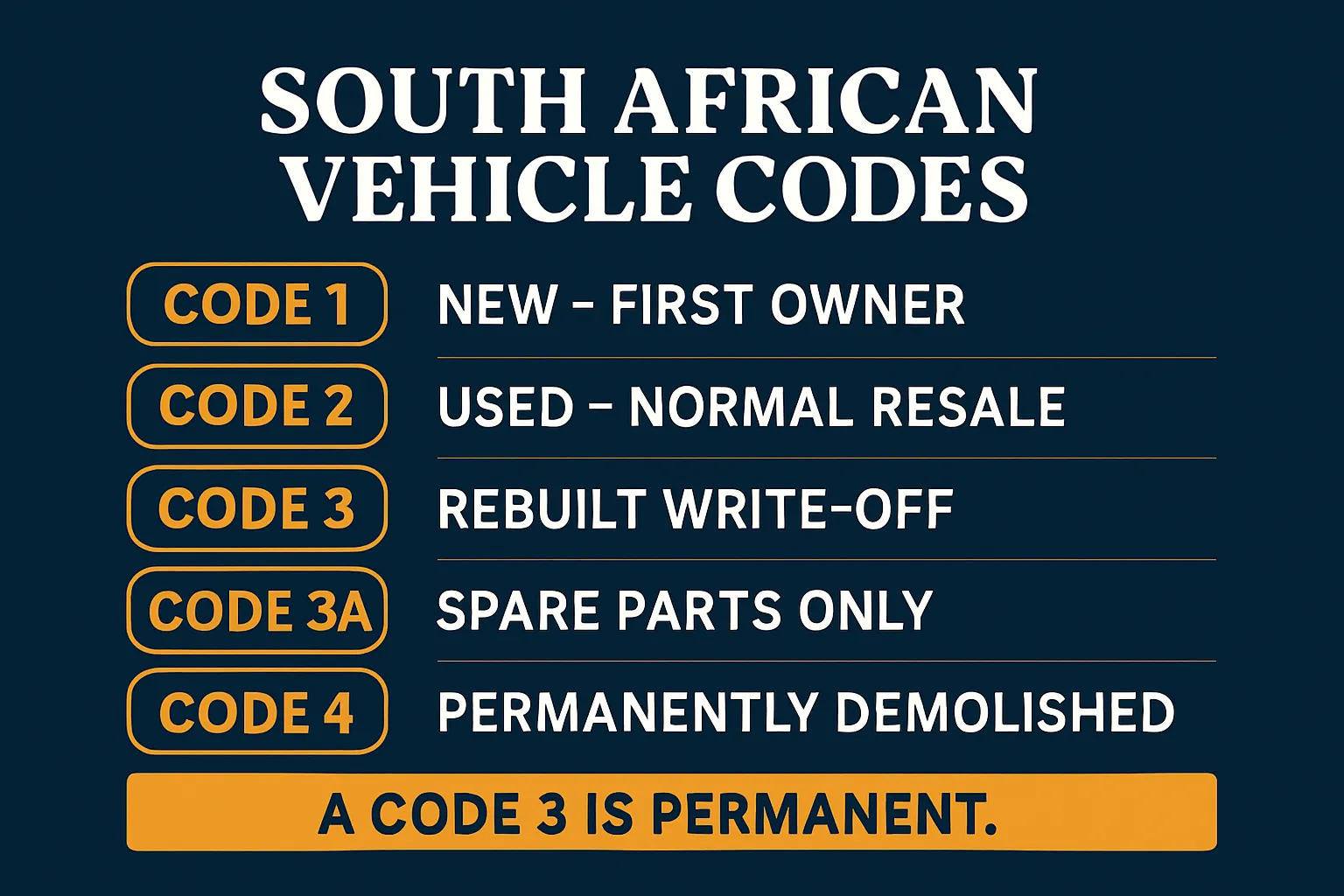
A Code 3 vehicle is one that was written off, rebuilt, put through police clearance and passed a roadworthy test.[4] It is legal to drive and legal to sell. What it is not is equivalent to the car it used to be.
What Code 3 Costs You
If your car is written off and rebuilt, three things follow, and they are worth understanding before you agree to buy a wreck back from an insurer and repair it.
The value drops and stays down. Code 3 vehicles hold only "50% to 70% of their market value" compared with equivalent cars that were never written off.[4] On a R200,000 car that is R60,000 to R100,000 of value gone, permanently.
Insurance and finance get difficult. Banks and underwriters treat written-off vehicles very differently from ordinary used cars — "a handful of insurers may provide some form of cover, albeit at a significantly reduced market value", and financing generally means falling back on a personal loan rather than vehicle finance.[4]
The code is permanent. There is no process for rehabilitating a Code 3 back to Code 2 through good repair work. Once recorded, the vehicle carries it for the rest of its life.[4]
None of this makes buying back and repairing a written-off car automatically wrong — for a well-loved vehicle with a sound cabin structure it can still make sense. It does mean the sums have to be done with the post-repair value in mind, not the pre-accident one.
The Write-Offs You Cannot Look Up
This is the part that matters most if you are buying a used car in Centurion rather than repairing your own.
The insurance industry launched a free public VIN lookup so buyers could check whether a vehicle had been written off. It covers Code 3, Code 3A and Code 4 vehicles only, and requires your name, ID number and the VIN.[7]
There is a significant gap in it. Insurers had committed to adding Code 2 write-offs — vehicles declared "uneconomical to repair" but never recoded — and then reversed that decision in April 2024, arguing that publishing the records would compromise people who buy such vehicles and repair them properly. The motor body repair association pushed back, questioning why the same concern did not extend to the safety of the eventual consumer.[6]
The practical consequence: a car written off as "Code 2 uneconomical to repair", bought as salvage, repaired to whatever standard, and resold, is invisible on the free public check. It still shows as an ordinary Code 2 used car.
Watch: Buying a Car From a SA Dealership — Your Checklist (Cars.co.za)
South African motoring publication Cars.co.za runs through the checks worth making before you buy a used car from a dealership — the practical companion to everything above on spotting previous accident damage.
Worth noting: when we checked the public VIN lookup tool in August 2026 it returned an application error rather than a search form. If you rely on it, confirm it is actually working before treating a clean result as meaningful. Commercial vehicle-history providers such as TransUnion and Lightstone also offer paid checks, though these report finance, police and valuation status rather than a repair history.
If you are buying a used car and anything about the panel gaps, door alignment or tyre wear looks off, a pre-purchase inspection by a workshop that can measure the shell is worth far more than the code on the paperwork.
After the Repair: Safety Systems and ADAS
Modern cars carry driver-assistance systems — autonomous emergency braking, lane-keeping, adaptive cruise, blind-spot monitoring — that depend on cameras and radar sensors mounted in the windscreen, grille, bumpers and mirrors. Move any of that hardware, and the system's view of the world moves with it.
SAMBRA, the national motor body repair association, is explicit that this changes what a collision repair has to include. Its national director, Juan Hanekom, notes that "following an accident — or even the replacement of a windscreen, bumper or side mirror — these systems often require precise recalibration", warning that "if ADAS components are not correctly recalibrated after repairs, motorists could unknowingly be driving with safety systems that are no longer functioning accurately".[8] On structural work specifically, he puts it simply: "repairing visible damage is no longer enough" — technicians may also need to "verify crash sensors, inspect wiring harnesses and connectors, recalibrate safety systems".[8]
Recalibration comes in two forms. Static calibration is "carried out in a workshop environment on a level surface" using specialist targets and equipment; dynamic calibration requires the vehicle "to be driven at a prescribed speed over a certain distance".[9] Some vehicles need both. The critical point is that a miscalibrated camera does not usually announce itself with a warning light — the car simply misjudges distances.
When you accept a structural repair, ask specifically whether ADAS recalibration was performed and whether you can have the report.
Choosing a Structural Repairer
Not every body shop is equipped or accredited for structural work, and the distinction is formalised. SAMBRA grades its members, and two grades matter here: a Non-Structural Repairer "can repair and replace panels that bolt on and off such as bumpers, fenders, bonnets, valance, spoilers and paintless dent removal", while a Structural Repairer "can perform all structural and non-structural repairs to passenger and light commercial vehicles".[10]
Before committing a structurally damaged car to a workshop, ask:
- Do you measure against manufacturer data, and will I get the printout? A before-and-after measurement report is the only objective proof the shell is back to specification.
- Is the car going on a straightening bench? Structural pulling needs proper anchoring and a measuring system, not a chain and an eye for it.
- Which members are being replaced versus pulled, and why? A shop that can explain this is thinking about the metallurgy, not just the shape.
- Will ADAS recalibration and safety-system checks be done? On any recent vehicle, this should be quoted, not assumed.
- What is guaranteed, and in writing?
If the damage came through an insurance claim, remember you are entitled to choose where the work is done — our page on insurance panel beating in Centurion explains how that process works.
Frequently Asked Questions
What does Code 3 mean for a car in South Africa?
Code 3 means the vehicle was involved in an incident, declared unfit for use, and required substantial rebuilding. It is recorded against the vehicle on the national registration system. A Code 3 car that has been rebuilt, police cleared and passed a roadworthy test is legal to drive and to sell, but it holds only 50% to 70% of the market value of an equivalent car that was never written off, and the code is permanent.
At what point does an insurer write a car off in South Africa?
There is no industry-wide threshold. The South African Insurance Association has confirmed that individual insurers apply their own criteria relative to each vehicle's value. As a general guide, repair costs above 60% to 70% of the car's insured or market value usually result in a write-off, but at least one major insurer says it uses historical salvage data for the specific model instead of a fixed percentage. Two people with identical damage insured by different companies can get different outcomes.
Can a Code 3 vehicle be insured?
Sometimes, but not easily. Reporting on the SA market notes that only a handful of insurers will provide some form of cover on a Code 3 vehicle, and then at a significantly reduced market value. Vehicle finance is similarly difficult, with a personal loan often the realistic alternative. Check with your specific insurer before buying a Code 3, not after.
Can I sell a Code 3 car?
Yes. A rebuilt, police-cleared and roadworthy Code 3 vehicle can legally be sold. The code stays on the vehicle record permanently and any informed buyer will price accordingly, so expect to achieve well below the equivalent Code 2 value. Disclosing the code honestly is the right approach, and buyers can in any case check Code 3 status on the insurance industry's public VIN lookup.
Can a bent chassis be straightened?
Often yes, where the structure has moved but not been destroyed. The car is anchored to a straightening bench, measured against the manufacturer's dimensional data, and pulled in controlled stages with the measuring system live throughout. Members that are too badly deformed or work-hardened to recover are cut out and replaced rather than pulled. The test of a proper job is that the finished shell measures to specification, not that it looks straight.
Is it worth fixing structural damage?
It depends on the repair cost as a share of the car's value, not on the rand figure alone. If the quote approaches 60% to 70% of what the car is worth, an insurer would likely write it off, and repairing it privately means carrying a vehicle worth substantially less than the money you put into it. Below that, and with a sound cabin structure, structural repair is routinely worthwhile when it is done to specification.
What is a crumple zone and why does it matter in a repair?
A crumple zone is a section of the vehicle structure engineered to deform in a controlled way during an impact, absorbing crash energy so that less of it reaches the occupants. Because the steel is permanently deformed once it has done that job, a damaged crumple zone is generally replaced or sectioned to manufacturer specification rather than simply pulled back into shape. Restoring the shape does not restore the way the metal behaves in a second impact.
How do I know if my car has structural damage?
The usual signs are doors or the boot no longer closing cleanly, uneven or inconsistent panel gaps, the car pulling to one side, or uneven tyre wear developing after an accident. None of these are conclusive on their own. The only reliable answer comes from measuring the shell against the manufacturer's data on a straightening bench, which is why a proper structural assessment is worth having before you commit to any repair.
Can I check whether a used car was written off?
Partly. The insurance industry runs a free VIN lookup covering Code 3, Code 3A and Code 4 vehicles. The significant gap is that vehicles written off as "Code 2 uneconomical to repair" were deliberately left out, so a car that was written off, repaired and resold under Code 2 will not appear. Paid providers such as TransUnion and Lightstone offer checks on finance, police and valuation status. For structural history specifically, a pre-purchase inspection is more reliable than any database.
Structural Damage Assessment in Centurion
If your car has taken a serious hit, the useful first step is finding out whether the structure actually moved — before you make decisions about claiming, repairing or selling. We assess accident damage properly rather than quoting off a photograph, and we will tell you honestly if what you are looking at is a write-off rather than a repair.
See our collision repair service in Centurion for what the work involves, call us on 068 114 4891, or send photos through the form on this page and we will come back to you.
![Car Rust Repair Cost in South Africa: Treatment & Prices [2026]](/images/blog-rust-repair-cost-south-africa.webp)
![Bumper Repair Cost in South Africa: Repair vs Replace [2026]](/images/hero-bumper.webp)