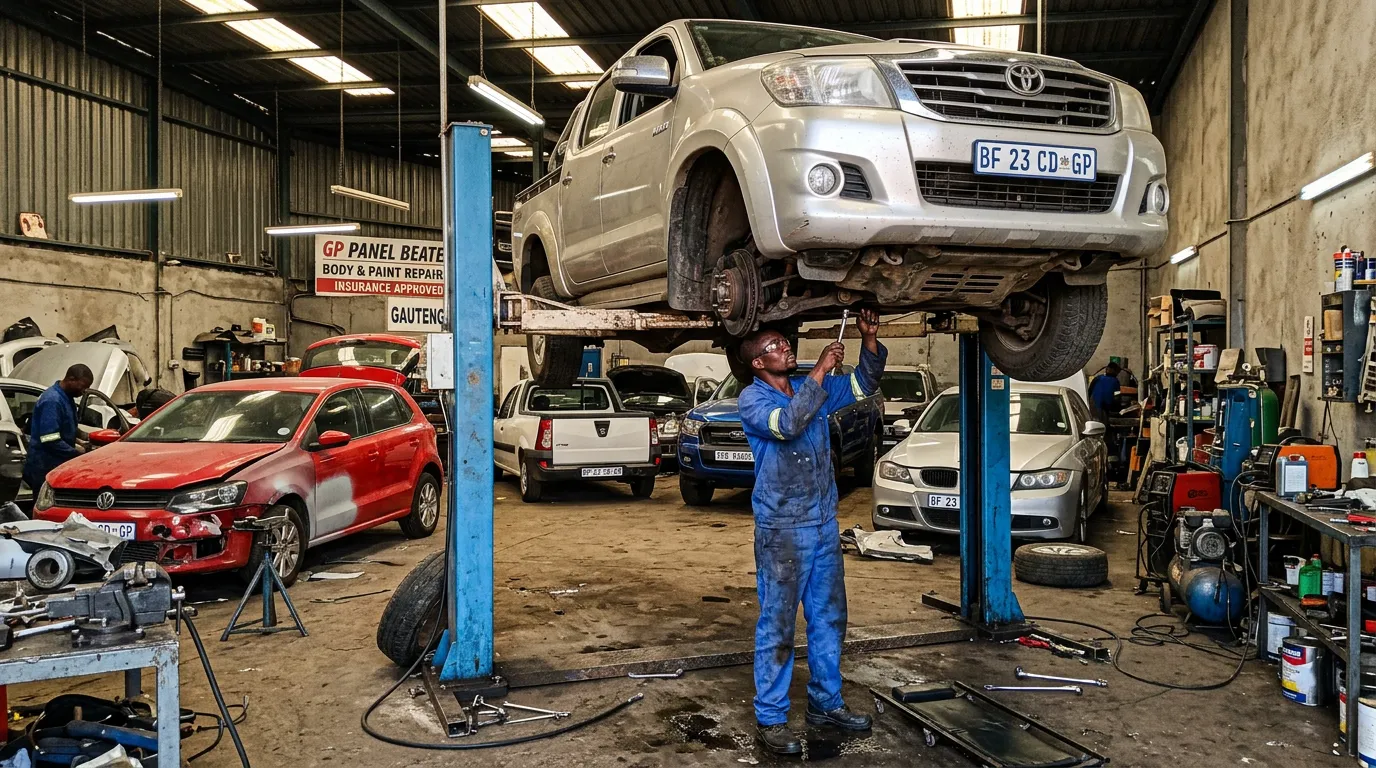
Panel beating takes anywhere from 30 minutes to 4 weeks depending on the repair.[1] A single small dent via PDR is done in under an hour. Scratch and bumper repairs take 1–3 days. Minor collision work takes 3–5 days. Major collision repairs with structural damage take 2–4 weeks. If you're going through insurance, add 3–7 working days for assessment and authorisation before work begins.
Key Takeaways
- PDR single dent: 30–60 minutes (often while you wait)
- Scratch/bumper repair: 1–3 working days
- Minor collision: 3–5 working days
- Major collision: 2–4 weeks
- Insurance authorisation adds 3–7 days before work starts
Whether you need the car for work, school runs, or just daily life, knowing realistic repair timelines helps you plan. This guide gives you honest, practical timelines based on how repairs actually work in Centurion and Gauteng workshops — not best-case scenarios.
Repair Timelines by Job Type
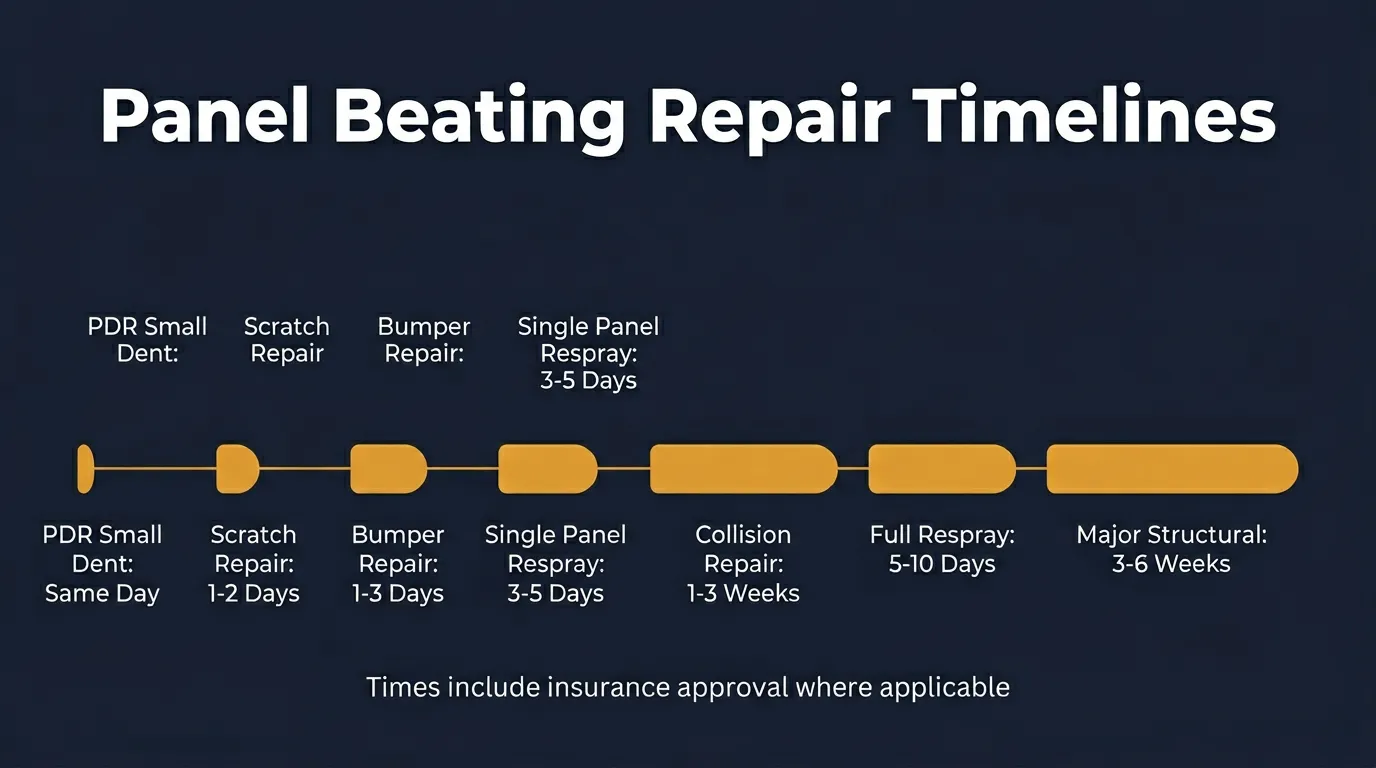
| Type of Repair | Repair Time | + Insurance Auth. | Total with Insurance |
|---|---|---|---|
| PDR — single small dent | 30–60 min | N/A (pay cash) | 30–60 min |
| PDR — hail damage | 1–3 days | +3–7 days | 4–10 days |
| Scratch repair (single panel) | 1–2 days | +3–5 days | 4–7 days |
| Bumper repair | 1–3 days | +3–5 days | 4–8 days |
| Single panel respray | 1–3 days | +3–5 days | 4–8 days |
| Full body respray | 5–10 days | N/A (cosmetic) | 5–10 days |
| Minor collision repair | 3–5 days | +3–7 days | 6–12 days |
| Major collision repair | 2–4 weeks | +5–9 days | 3–5 weeks |
Why Repair Timelines Vary
1. Parts Availability
This is the single biggest cause of delays in Gauteng panel beating workshops. Common parts for popular vehicles like Toyota Hilux, VW Polo, and Hyundai Tucson are usually available within 1–3 working days from local suppliers. However, parts for luxury vehicles, older models, or specific trim levels can take 1–3 weeks to source — sometimes requiring import orders.
Tip: Always ask about parts lead time upfront.
A workshop might be able to complete the labour in 3 days, but if the replacement bumper takes 10 days to arrive, your car will be there for nearly two weeks.
2. Insurance Authorisation
Insurance repairs add a layer of process that directly affects timelines:
- Workshop submits assessment and quote to insurer: 1–2 days
- Insurer reviews and assigns assessor: 1–3 days
- Assessor visits and reviews: 1–2 days
- Authorisation issued: 1–2 days
That's 4–9 working days before any work begins. Workshops that handle insurance claims regularly know how to keep this process moving and avoid unnecessary delays.
3. Hidden Damage
One of the most common reasons for timeline extensions is hidden damage discovered after stripping. A bumper that looked like it just needed a respray might reveal a cracked mounting bracket behind it. A dented fender might be hiding damage to the inner wheel arch. The workshop submits a supplementary claim, which requires another round of assessment and authorisation.
This isn't the workshop being slow — it's a necessary and standard part of proper collision repair. A workshop that doesn't check for hidden damage isn't doing the job properly.
4. Paint Curing Time
Automotive paint needs time to cure properly between stages. Each coat of primer, base colour, and clear coat has a minimum drying time that cannot be rushed without compromising the finish. Centurion's warm, dry climate is actually favourable for paint curing compared to coastal areas, but it still takes time.
5. Workshop Capacity
During busy periods — particularly after Gauteng hail season (October to March) — workshops may have a queue of vehicles waiting. Booking in advance and choosing a workshop that communicates openly about their schedule helps manage expectations.
The Repair Process: What Happens Each Day
For a typical moderate repair — a dented and scraped fender with paint damage — here's what a realistic daily breakdown looks like:
Day 1: Strip and Assess
The damaged panel is removed or stripped back. The full extent of damage is assessed. If it's an insurance job, photos are taken and any supplementary damage is reported. Parts are ordered if needed.
Day 2: Metalwork
Panel beating, straightening, or fitting replacement panels. Filler is applied to smooth out remaining imperfections. The filler needs to cure before it can be sanded.
Day 3: Preparation
Sanding, priming, and masking. The prepared surface needs to be perfectly smooth — any imperfection at this stage will be visible in the final finish. This stage is where the quality of the repair is largely determined.
Day 4: Painting
Base coat and clear coat applied in the spray booth. Multiple coats with flash-off time between each. The vehicle stays in the booth or clean area while the spray painting cures.
Day 5: Finish and Quality Check
Cut and polish the painted surface. Reassemble all removed components. Align panels. Final quality inspection checking paint match, panel gaps, and overall fitment. Clean the vehicle and prepare for collection.
Five working days for a moderate repair is standard — and each day involves genuinely necessary work. Be cautious of workshops that promise significantly faster turnarounds for equivalent work, as something is likely being cut short.
How to Minimise Your Time Without a Car
- Ask about rental vehicles — if you're claiming through insurance, check whether your policy includes car hire benefit. Many Centurion-area workshops can coordinate this for you.
- Time it right — if the repair isn't urgent, booking during quieter months (May to September, outside hail season) often means faster turnaround.
- Combine repairs — if you have multiple small issues (a dent, a scratch, a faded panel), getting them all done at once is more efficient than separate visits.
- Communicate — ask your workshop for regular updates. A good panel beater in Centurion will proactively tell you about delays rather than letting you wonder. WhatsApp progress updates have become standard practice at most Monavoni-area workshops.
- Consider PDR for dents — if your damage is dent-only with no paint damage, paintless dent removal can be done same-day or next-day, drastically reducing your time without a vehicle.
Red Flags: When Timelines Should Concern You
- No communication — if the workshop doesn't return calls or provide updates, there may be a problem.
- Repeated "just one more day" — this usually indicates poor planning or resource issues.
- Car sitting untouched — if you visit and your vehicle hasn't been touched after the agreed start date, ask directly what's happening.
- No clear explanation for delays — legitimate delays (parts, supplementary claims) should be explainable. Vague excuses are a concern.
A reputable workshop in the Centurion and Gauteng area will be transparent about timelines, communicate proactively about any changes, and provide realistic estimates from the outset rather than telling you what you want to hear.
Sources
- MechanicBuddy.co.za — Repair timelines and turnaround data from SA workshops
- SAMBRA (South African Motor Body Repairers' Association) — Industry repair process standards
- AutoTrader South Africa — Repair type descriptions and process overview
- AA South Africa — Insurance claims process timelines and advice
Frequently Asked Questions
How long does panel beating take?
Panel beating timelines range from 30 minutes for a single small dent (PDR) to 4 weeks or more for major collision repair. Minor repairs like scratches and bumper fixes take 1–3 days. Moderate single-panel repairs take 3–5 days. Add 3–7 working days for insurance authorisation if you're claiming.
Why is my car taking so long at the panel beater?
The most common reasons for delays are: parts on back-order (especially for luxury or older vehicles), insurance authorisation waiting times, hidden damage discovered during stripping that requires supplementary claims, paint curing time between coats, and high workshop demand during hail season. Ask your workshop for a specific explanation — legitimate delays should have clear reasons.
How long does a bumper repair take?
A bumper scratch repair takes 1–2 days. A cracked bumper repair including respraying takes 2–3 days. If the bumper needs full replacement, add 2–5 working days for parts delivery, making the total timeline 4–8 days. Modern bumpers with integrated sensors add complexity and time.
Can panel beating be done in one day?
Yes, for minor work. Paintless dent removal (PDR) for small dents is typically completed in under an hour. Light scratch polishing and minor scuff repairs can also be same-day jobs. However, any repair that involves painting requires at least overnight curing time, so one-day completion isn't realistic for resprayed repairs.
How long does it take to respray a car panel?
A single panel respray takes 1–3 working days. Day one covers preparation (sanding, priming, masking), day two is painting (base coat and clear coat application), and day three is curing, cutting, and polishing to a final finish. Rushing this process compromises quality and durability.
![Structural Damage & Car Write-Offs in South Africa: Code 3 Explained [2026]](/images/blog-chassis-structural-repair-cost.webp)
![Car Rust Repair Cost in South Africa: Treatment & Prices [2026]](/images/blog-rust-repair-cost-south-africa.webp)