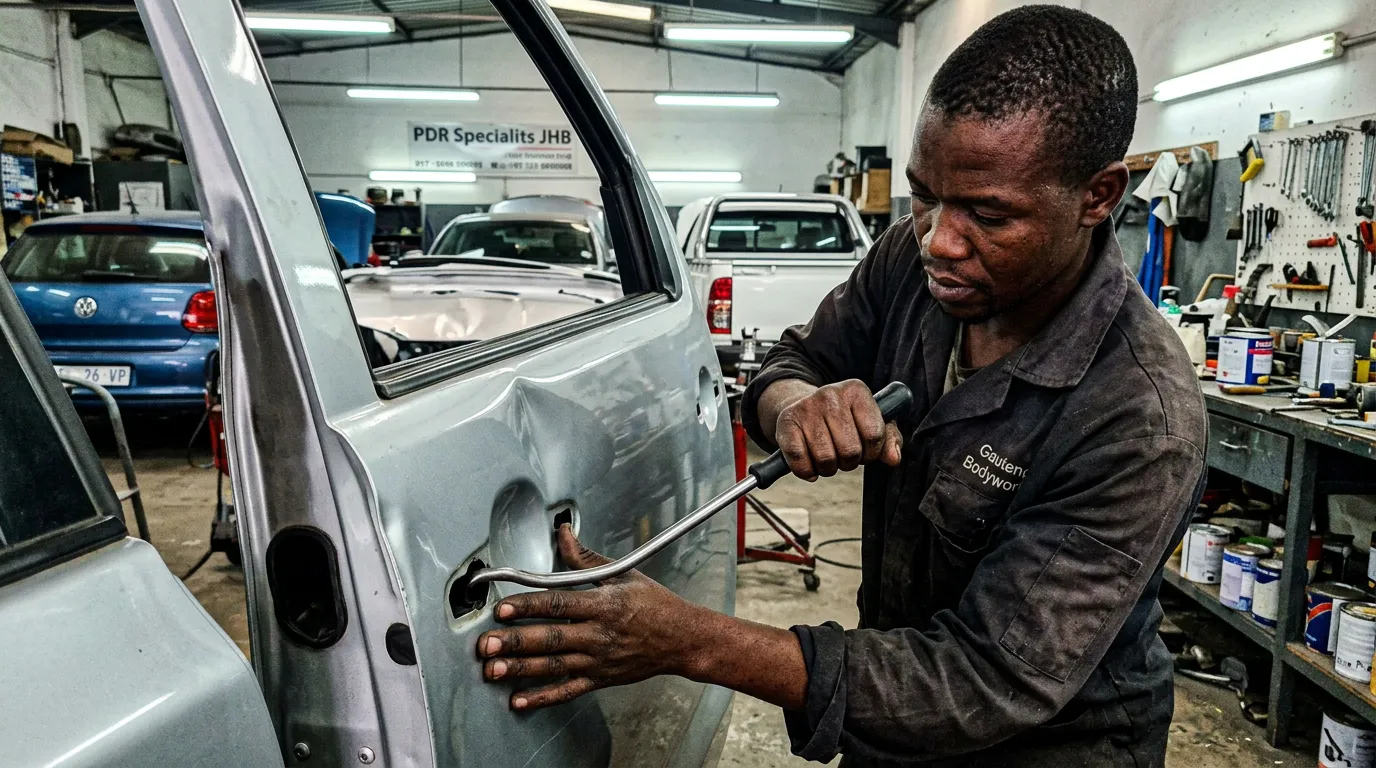
Paintless dent removal (PDR) in South Africa costs between R500 and R3,000 per dent, depending on size and location.[1] A small coin-sized door ding starts at R500–R1,500, medium dents cost R1,500–R3,000, and hail damage across multiple panels runs R3,000–R20,000.[2] PDR is typically 40–60% cheaper than traditional panel beating because it eliminates the need for filler, primer, and paint.
Key Takeaways
- Small dent PDR: R500 – R1,500 | Medium: R1,500 – R3,000 | Hail: R3,000 – R20,000
- PDR saves 40–60% vs traditional repair for the same dent
- Preserves factory paint — better for resale value than any respray
- Most single dents fixed in 30–60 minutes, often while you wait
- Only works when paint is intact — cracked paint needs traditional repair
If you've got a door ding from a shopping trolley at Centurion Mall, a car park dent, or hail damage on your roof, PDR is almost certainly the repair method you want. But is it always the right choice? This guide covers everything you need to know.
What Is Paintless Dent Removal?
PDR is a technique that removes dents from vehicle panels without using filler, sanding, or repainting. A trained technician accesses the back of the damaged panel — either through existing openings or by removing interior trim — and uses specialised metal rods and tools to carefully push and massage the dent out from behind.
The result is a panel restored to its original shape with the factory paint completely intact. No filler, no respray, no colour matching concerns. The repair is essentially invisible when done properly.
PDR Cost in South Africa: What You'll Pay
Based on real quote data from workshops across Gauteng and nationally, including pricing from AutoTrader South Africa[1] and the MechanicBuddy.co.za database:[2]
| Dent Size | PDR Cost | Timeframe | Example |
|---|---|---|---|
| Small (coin-sized) | R500 – R1,500 | 30–60 min | Shopping trolley ding, door edge dent |
| Medium | R1,500 – R3,000 | 1–2 hours | Larger car park dent, minor collision dent |
| Multiple dents (hail) | R3,000 – R20,000 | 1–3 days | Hail damage across multiple panels |
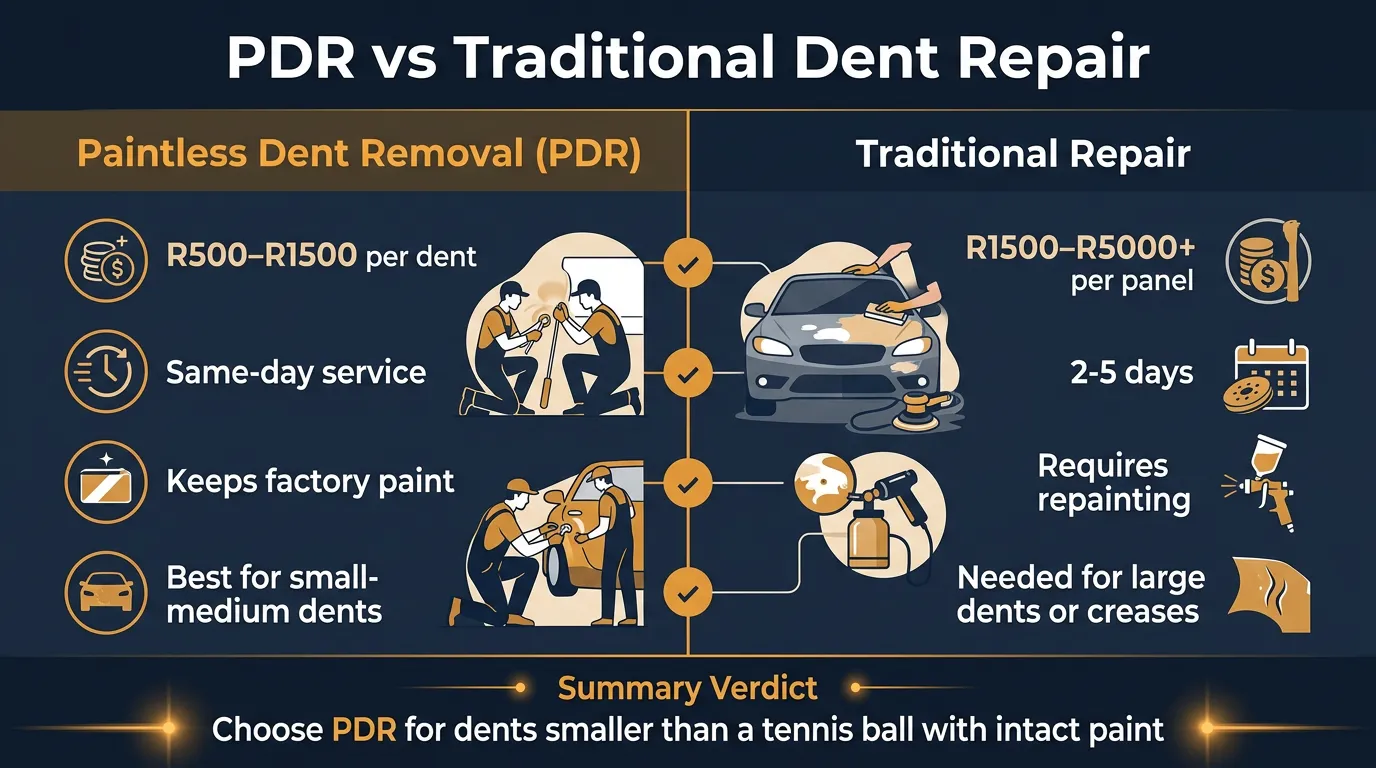
According to AutoTrader South Africa, a shallow dent starts from around R550 using PDR.[1] Industry data confirms that PDR is typically 40–60% cheaper than the traditional panel beating alternative for the same dent, primarily because it eliminates the cost of filler, primer, paint, and clear coat.
PDR vs Traditional Panel Beating: Cost Comparison
| Repair Scenario | PDR Cost | Traditional Cost | Saving |
|---|---|---|---|
| Single door ding | R500 – R1,000 | R1,500 – R3,500 | 60–70% |
| Medium quarter panel dent | R1,500 – R2,500 | R3,000 – R5,000 | 50% |
| Light hail (roof + bonnet) | R3,000 – R8,000 | R10,000 – R25,000 | 60%+ |
Beyond cost, PDR has a significant advantage in preserving your vehicle's value. A car with its original factory paint is always worth more than one that's been resprayed — car buyers and dealers can detect resprays with paint thickness gauges, and they'll negotiate accordingly.
When PDR Works — And When It Doesn't
PDR Is Ideal For:
- Round, shallow dents where the paint surface is intact
- Door dings and shopping trolley dents
- Hail damage (the most common application)
- Dents on large, flat panels (doors, roof, bonnet, boot)
- Minor car park damage
PDR Won't Work When:
- The paint has cracked, chipped, or flaked at the dent
- The dent has a sharp crease that has stretched the metal beyond recovery
- The dent is on the very edge of a panel or on a body line
- There's no access to the back of the panel (some structural areas)
- Previous body filler has been applied to the area
A reputable dent removal specialist in Centurion will tell you upfront whether PDR is viable for your specific dent. If the paint is cracked, you'll need traditional repair with filler and respray regardless of the dent size.
Benefits of PDR Beyond Cost Savings
Speed
Most single-dent PDR repairs are completed in under an hour — often while you wait. Traditional repair on the same dent would take 1–3 days when you factor in filler curing, priming, painting, and clear coat drying.
No Colour Matching Issues
Because PDR doesn't involve any painting, there's zero risk of colour mismatch. This is particularly valuable for vehicles with difficult-to-match paint colours like pearl whites, colour-shift metallics, or tri-coat finishes.
Environmentally Friendly
PDR uses no chemicals, produces no paint fumes, and generates no waste. Traditional panel beating involves body filler, chemical primers, paint solvents, and clear coat — all of which have environmental implications.
Preserves Factory Finish
Your vehicle's factory paint was applied in a controlled environment under ideal conditions — baked on at temperatures no aftermarket spray booth can replicate. Preserving that finish maintains your vehicle's appearance, protection, and resale value far better than any respray.
How to Tell If Your Dent Qualifies for PDR
Before you book in, here's a quick self-assessment:
- Check the paint — run your finger over the dent. Is the paint smooth and unbroken? If yes, PDR is likely viable.
- Check the shape — round, smooth dents respond best to PDR. Sharp creases or folds are problematic.
- Check the location — dents on large, flat panel areas (doors, roof, bonnet) are ideal. Dents on panel edges or near windscreen frames are more challenging.
- Check the size — PDR works on dents from coin-sized up to roughly palm-sized. Very large deformations typically need traditional methods.
The most reliable approach is to send photos via WhatsApp to your local workshop for a quick assessment. Most panel beaters in the Centurion area offer free estimates from photos, and workshops with dedicated paintless dent removal services can usually tell you within minutes whether PDR will work for your damage.
Sources
- AutoTrader South Africa — Shallow dent PDR from R550, larger dents from R3,000+
- MechanicBuddy.co.za — Real PDR and dent removal quotes from SA workshops
- HJ Bosch & Sons (Pretoria/Centurion) — SAMBRA accredited PDR specialists
- SAMBRA (South African Motor Body Repairers' Association) — Industry standards and accredited workshops
Frequently Asked Questions
How much does paintless dent removal cost in South Africa?
PDR costs R500–R1,500 for a small coin-sized dent, R1,500–R3,000 for medium dents, and R3,000–R20,000 for multiple dents such as hail damage. PDR is typically 40–60% cheaper than traditional panel beating because it doesn't require filler or painting.
Is PDR cheaper than traditional panel beating?
Yes. PDR is consistently cheaper because it eliminates the costs of body filler, primer, paint, and clear coat. A door ding that costs R500–R1,000 with PDR would cost R1,500–R3,500 with traditional repair. The savings increase with multiple dents — hail damage PDR can save 40–60% compared to conventional methods.
What is the difference between PDR and panel beating?
PDR pushes dents out from behind the panel using specialised tools, preserving the original paint. Traditional panel beating uses filler, sanding, and respraying to repair the visible surface. PDR is faster, cheaper, and preserves factory paint, but only works on dents where the paint hasn't cracked.
Can all dents be fixed with PDR?
No. PDR works best on round, shallow dents where the paint is intact. It's not suitable for sharp creases, dents with cracked paint, panel edge damage, or areas with no access to the back of the panel. A trained PDR technician can assess your specific dent and advise on the best repair method.
How long does PDR take?
A single small dent can be fixed in 30–60 minutes. Multiple dents or hail damage typically take 1–3 days depending on the number of dents and panels affected. This is significantly faster than traditional repair, which requires curing time for filler and paint between each stage.
![Structural Damage & Car Write-Offs in South Africa: Code 3 Explained [2026]](/images/blog-chassis-structural-repair-cost.webp)
![Car Rust Repair Cost in South Africa: Treatment & Prices [2026]](/images/blog-rust-repair-cost-south-africa.webp)