![Car Rust Repair Cost in South Africa: Treatment & Prices [2026]](/images/blog-rust-repair-cost-south-africa.webp)
Rust repair in South Africa costs between R850 and R20,000+, and where you land in that range depends almost entirely on how long you left it. Surface rust on a single panel starts at around R850 and runs to R2,500. Once corrosion eats through the metal and a section has to be cut out and welded in, you are looking at R4,000 to R12,000. Structural rust in a sill or chassis rail on a bakkie or SUV runs R6,000 to R20,000 and up. Rust is the one kind of car damage that gets more expensive every month you ignore it — and the one your insurance will never pay for.
Key Takeaways
- Surface rust: R850 – R2,500 per panel | Pitted or scale rust: R2,500 – R7,000
- Penetrating rust needing a welded patch: R4,000 – R12,000+
- Structural sill or chassis-rail rust: R6,000 – R20,000+
- Preventative rustproofing: roughly R1,750 – R26,500 depending on vehicle and package
- No South African insurer covers rust — we read ten policy documents and all ten exclude it
- Structural rust fails a roadworthy, which matters most when you sell the car
Rust Repair Cost by Stage (2026)
Rust pricing follows the damage, not the panel. The same door can cost R900 or R9,000 depending on whether the corrosion is sitting on top of the paint or has already gone through the steel. These are the indicative ranges we work to in the Centurion market:
| Stage of Rust | What the Repair Involves | Price Range |
|---|---|---|
| Stone-chip cluster | Seal the chips before rust starts | R500 – R1,500 |
| Surface rust, single panel | Sand back, phosphate treat, rust-inhibiting primer, refinish | R850 – R2,500 |
| Surface rust, full panel | As above across the whole panel, blended into adjacent panels | R1,500 – R3,500 |
| Scale or pitted rust | Heavier removal, filling of pitting, full refinish | R2,500 – R7,000 |
| Penetrating rust (holes) | Cut out the rusted section, weld in fresh metal, prime, paint, cavity wax | R4,000 – R12,000+ |
| Structural (sill, chassis rail) | Panel replacement or chassis-rail sectioning, full corrosion protection | R6,000 – R20,000+ |
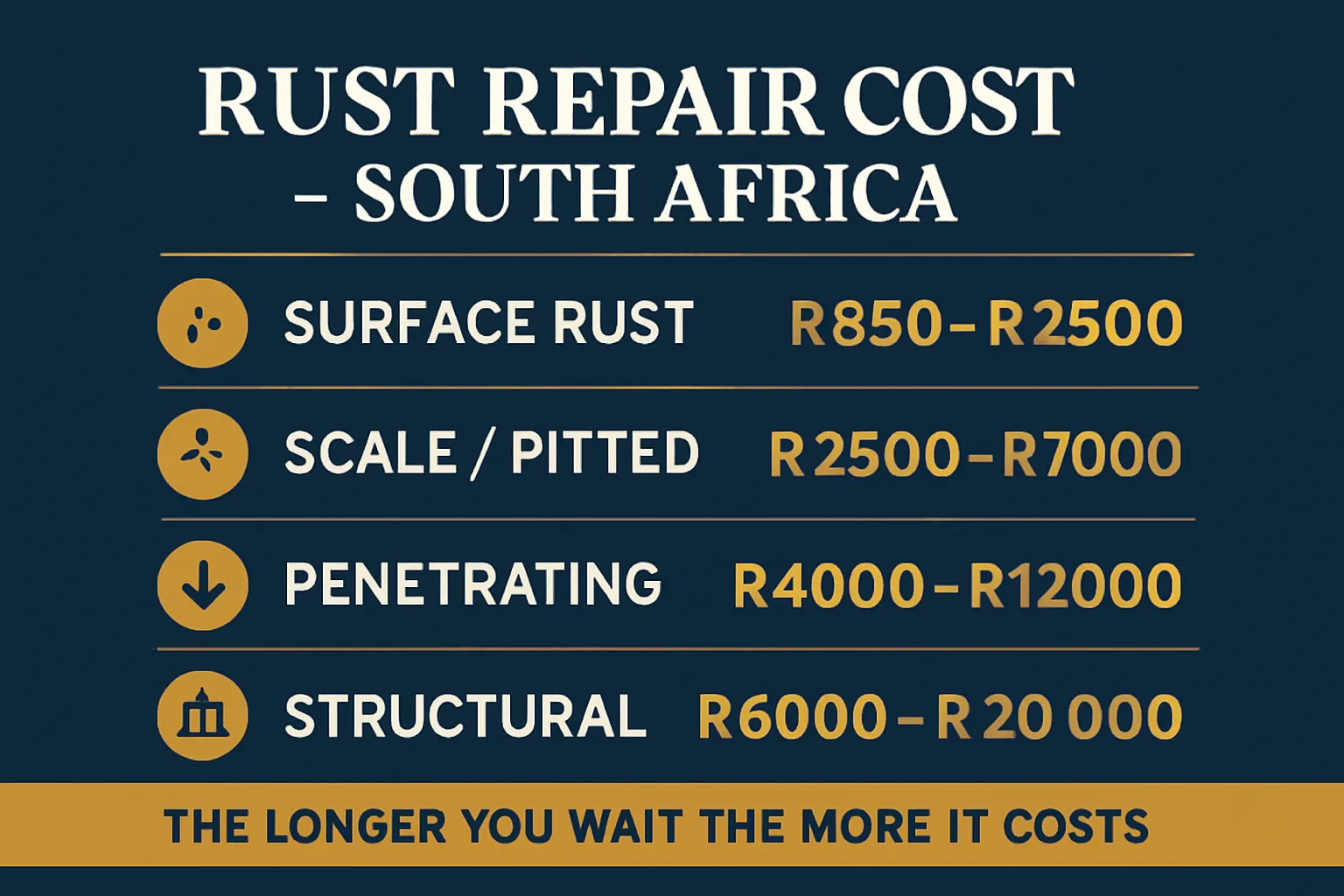
Every quote still depends on inspection. Two cars with identically sized bubbles on the rear arch can be two very different jobs once the wheel is off, because what matters is how far the corrosion has travelled behind the paint. If rust has destroyed a panel outright, replacing it rather than repairing it becomes the sensible route, and a supplied, fitted and resprayed door or fender typically lands in the R4,500 to R12,000 band.
Why Waiting Multiplies the Bill
Rust is not a static blemish. It is an ongoing chemical reaction spreading underneath paint you cannot see through, which is why the cost curve is so steep. A bubble the size of a five-rand coin on a wheel arch is usually a far larger patch of corroded metal behind the paint.
The progression is predictable. Surface rust sits on the outside of the steel and can be sanded back, treated and resealed — a few hundred to a couple of thousand rand. Left alone, it pits the metal, so now there is filling to do as well as treating. Left longer, it perforates, and the repair becomes a welding job: cut out the rotten section, fabricate and weld in fresh metal, then seal, prime, paint and cavity-wax it.
This is also why a knock that looks trivial deserves attention. Juan Hanekom, national director of SAMBRA — the South African motor body repair association — puts it this way: "people tend to look for scratches or chips, but the reality is that paint can be stretched or weakened without visible signs. Once that protective barrier is compromised, moisture has a way of finding its way in." On what follows, he is blunt: "rust doesn't need much to start. And once it takes hold, it spreads beneath the surface. By the time it becomes visible, the damage is often far more extensive than the original dent."[22]
In practice, a R1,200 job deferred through one winter is commonly a R6,000 job by the time it gets attention. This is the one repair where getting a quote early genuinely saves money rather than just satisfying curiosity.
Why Gauteng Cars Rust Too
Most South Africans assume rust is something that happens to cars in Durban and Cape Town. That assumption costs Highveld owners real money, because it is only half right.
Research mapping corrosion rates across South Africa found inland industrial sites corroding steel at rates that rival parts of the coast — Germiston at 51 micrometres per year, Sasolburg at 50 and Secunda at 38, driven by industrial sulphur emissions rather than sea salt.[1] True coastal exposure is still far more aggressive — Melkbosstrand measured 460 — but the idea that Gauteng air is neutral toward steel does not survive the data.
Add the local specifics and the picture makes sense:
- Hail and stone chips. Every chip is a breach in the paint. Gauteng's summer hail season does this at scale, which is why unrepaired hail damage so often becomes rust a year or two later.
- Summer thunderstorms. Heavy rain followed by heat means repeated wet-dry cycling, which is harder on exposed steel than constant damp.
- Gravel and construction roads. Common around Centurion's developing areas, and brutal on sills and wheel arches.
- Trapped moisture. Blocked door and sill drain holes hold water against bare metal indefinitely. This is where the expensive rust starts, out of sight.
- Poor previous repairs. Filler over inadequately treated metal hides corrosion that quietly keeps spreading underneath.
Rust is a known issue in the local used market generally — Cars.co.za describes "rust and poor bodywork being endemic problems" when buying used in South Africa.[2] There is no reliable South African ranking of which models rust worst, so judge the individual car and the life it has had rather than the badge on the bonnet.
What Rustproofing Costs
Preventative treatment is far cheaper than repair, but South African pricing here is frustratingly opaque — most providers quote per vehicle rather than publishing rates. One specialist that does publish a full price list gives a useful sense of the upper end of the market for a 4x4, SUV or bakkie:[3]
| Package | Price (incl. VAT) |
|---|---|
| Corrosion preventive wax (rust removal + cavity wax) | R9,194 |
| Metal guard | R11,443 |
| Chassis & underbody treatment | R14,456 |
| Full treatment incl. cavity wax and engine bay | R21,908 – R26,450 |
Sedans and small SUVs sit lower, spanning roughly R1,750 to R20,200 depending on how much of the vehicle is treated.[3] Those are full specialist treatments carrying long warranties, at the thorough end of the market — and worth knowing that lifetime warranties of this kind typically require a paid annual inspection to stay valid.
Targeted preventative work costs considerably less, and for an everyday car that is usually the sensible spend: treat the vulnerable areas rather than the entire vehicle. Our rust treatment service in Centurion covers exactly that — underbody inspection, treatment of wheel arches, sills and door bottoms, and clearing the drain holes that trap water in the first place.
One thing to be clear about: "bakkie rubberising" is not underbody rustproofing. It is a polyurethane coating usually applied to the load bin only, and it is priced completely differently. Do not assume a rubberised bin means a protected chassis.
Is DIY Rust Treatment Worth It?
For a small patch of surface rust on an older car you plan to run into the ground, genuinely yes. Materials are cheap: rust converter sells from around R69 for a 150ml tin up to roughly R275 for 500ml, and rust-inhibiting aerosol primers run about R200 a can.[4] One owner documented a full DIY rust repair for under R1,500 including buying an angle grinder for the job.[5]
Two honest cautions. Many rust products on hardware-store shelves are formulated for gates and roofing rather than automotive panels, so a colour-matched finish is not what you will get. More importantly, rust converter applied over metal that has already perforated is cosmetic only — it changes the colour of the problem, not the structure. If you can push a screwdriver through it, or it is anywhere near a sill, chassis rail or suspension mounting point, it is a welding job and no product on a shelf will change that.
Watch: Ford Ranger Rust Removal (Chris Spooner Motoring)
A practical look at treating rust on a bakkie — cleaning back the corrosion, applying rust converter and sealing the underbody. Useful for seeing exactly what the DIY route realistically achieves on surface rust, and where it stops being enough.
Why Two Rust Quotes Differ by R6,500
Rust quotes vary more wildly than almost any other bodywork. A real example from a South African owner forum: a Hyundai Getz with roof rust was quoted R3,500, R5,100 and R10,000 by three different shops — the highest because that shop proposed replacing the entire roof panel rather than repairing it.[5] All three may well have been quoting honestly. They were quoting different jobs.
Labour rate is the other half of it, and the spread in South Africa is enormous. The Retail Motor Industry Organisation has publicly argued that insurers offer "on average R280 per hour to a SAMBRA member" while "the same offer to an OEM appointed dealer network is at least three times higher at approximately R840,00 per hour", and that the floor in the motor body repair market should be at least R350 per hour.[6] A three-fold difference in hourly rate, multiplied across a job measured in hours, explains most of what looks like inconsistency.
So when you compare rust quotes, compare the method, not just the number. Ask each shop three questions:
- Are you cutting the rust out or treating over it? Grinding back and sealing is entirely legitimate for surface rust. On perforated metal it is a temporary cosmetic fix that will bubble through again.
- What happens behind the panel? Good rust work seals and cavity-waxes the inside face. Skipping that is the single most common reason a rust repair fails within two years.
- What is guaranteed, and for how long? A workshop confident in its rust work will put a term on it in writing.
At our Monavoni workshop we quote rust only after getting the car up and looking behind the affected area, because the visible bubble is almost never the full story. For a wider view of bodywork pricing, see our Centurion panel beating cost guide.
How Long Rust Repair Takes
- Surface rust, one panel: 1–2 days including paint curing
- Single panel blended into adjacent panels: 3–5 days
- Welded patch repair: 3–5 days, longer where several areas are involved
- Structural or multi-panel work: 1–3 weeks
- Full respray with rust remediation: 5–10 working days, considerably longer for show-quality work
Paint curing sets a floor that cannot be rushed without compromising the finish. On older vehicles, parts availability is usually the bigger delay — and older vehicles are, of course, exactly the ones with rust.
Will Insurance Pay for Rust Repair?
Almost certainly not — and it is worth understanding why, because the reason is structural rather than a technicality buried in the fine print.
Comprehensive motor cover in South Africa insures sudden, unforeseen events. OUTsurance lists the perils it covers as loss or damage caused "in an accident or intentionally (including theft, hijacking, attempted theft or attempted hijacking), by fire, explosion, earthquake, storm, hail, flood, freezing or snow, or by animals".[7] Rust never appears on that list. It fails at the cover stage, before any exclusion clause is even reached.
Then the exclusions close the door a second time. We read the published policy wording of ten South African motor insurers for this guide. All ten exclude rust or gradual deterioration, and in every case the exclusion sits in the general exclusions that apply automatically to comprehensive cover — not in small print tucked inside the motor chapter:
| Insurer | What the policy actually says |
|---|---|
| Discovery Insure | Excludes "wear and tear, gradual deterioration or operating causes such as rust, mildew, insects, corrosion, rising damp, rising water table or decay"[8] |
| OUTsurance | Under "wear-and-tear and breakdown", excludes "any cause that was not sudden and unforeseen"[7] |
| King Price | Excludes "gradual deterioration, including rising damp, wear and tear, rust, mildew or fading"[9] |
| Naked | Excludes "a slowly operating cause such as rust, corrosion or decay", alongside "lack of maintenance"[10] |
| MiWay | Excludes "gradual deterioration, including rising damp, wear and tear, rust, mildew or fading"[11] |
| Dialdirect | Excludes rust as gradual deterioration, and separately "damage that occurred over a period of time and does not constitute a single incident"[12] |
| Budget & 1st for Women | Both exclude "gradual deterioration, including rising damp, wear and tear, breakage, depreciation, rust, mildew, perishing or fading"[13] |
| Santam | Its published example policy excludes "gradual damage (such as wear, tear, rust, mildew, corrosion, decay)"[14] |
Read enough of them and the real mechanism becomes obvious. The phrase doing the work is "sudden and unforeseen", which appears verbatim in the OUTsurance, MiWay, Budget, 1st for Women, Dialdirect and Naked wordings. Rust is not excluded because insurers dislike rust. It is excluded because it is not an event. Dialdirect puts the principle about as plainly as it can be put, excluding "damage that occurred over a period of time and does not constitute a single incident".[12]
Policy wording differs between products and changes over time. The Discovery guide quoted above took effect on 1 December 2025; the Santam document is Santam's own published example of a Classic policy and states it is accurate only up to August 2023. Always check your own policy schedule rather than relying on any general guide, including this one.
The scratch-and-dent trap
This is the one that catches people out. Scratch and dent cover is the optional cosmetic benefit most owners assume will handle bubbling paint on a wheel arch. It will not. King Price's scratch-and-dent section excludes "repairs to pre-existing damage, including rust and any other gradually-developing cause",[9] and Discovery's excludes "gradually developing causes such as rusting, fading, peeling of paint, cracked, corrosion or faded paintwork".[8] If you are paying extra for cosmetic cover expecting it to deal with rust, you are paying for something you will not be able to claim.
Where insurance does come into it: act promptly
There is one scenario where rust and insurance intersect expensively. If a hailstorm chips your paint or a knock leaves bare metal exposed, that damage is a covered event — but only while you act on it. Discovery's wording is blunt: "if your vehicle is in an accident and is used or driven before the repairs have been done, you will be responsible for the cost of repairs for any further damage to the vehicle related to the accident."[8]
In practice, a stone chip or hail dent left for eighteen months becomes a rust problem you fund yourself. Repairing damage while it is still a claimable event is far cheaper than paying cash for corrosion later. If you are weighing up whether to claim at all, our guide on insurance versus cash repairs works through the numbers.
Rust and Your Roadworthy: What the Law Says
There is a lot of confident nonsense online about rust and roadworthy tests, so it is worth being precise.
The starting point is section 42(1) of the National Road Traffic Act: "no person shall operate a motor vehicle, which is not in a roadworthy condition on a public road."[15] What "roadworthy" means in practice is set by regulation 140(1) of the National Road Traffic Regulations, which requires an examiner to "examine and test the motor vehicle... as prescribed in code of practice SABS 047 'Testing of motor vehicles for roadworthiness'."[16]
Here is the part most articles get wrong: no South African regulation mentions rust or corrosion by name. The equipment regulations cover brakes, lamps, steering, glass, tyres and seatbelts at length, but say nothing about body or chassis corrosion. Rust fails a roadworthy because of the testing standard that regulation 140(1) makes binding on every examiner — not because of a regulation number you can look up. Anyone quoting you a specific regulation for rust is inventing it.
What examiners do inspect includes the suspension and undercarriage.[17] On rust specifically, Arrive Alive states that "no rust is permitted in the chassis and under-carriage", noting that the "favourite rusty spots are in car cavities where moisture can collect".[18] Suzuki Auto South Africa frames the practical test as bodywork that "must be free of rust that might compromise the structure of the body or chassis".[19]
In our experience the working distinction is between surface rust on a panel — cosmetic, not usually a failure on its own — and rust that has penetrated a structural member such as a sill, chassis rail or suspension mounting point. The second fails, for good reason: corroded structural steel does not behave predictably in a crash. That distinction is practical workshop experience rather than a published rule, so treat a borderline case as something to have assessed rather than argued.
When you actually need a roadworthy
The most common trigger is selling the car. Regulation 138(1) requires certification of roadworthiness within 60 days prior to licensing for "a used motor vehicle of which the owner has changed", and for any vehicle that "has been found to be unroadworthy".[20]
Worth correcting a widespread myth: that 60-day figure is a window before licensing, not the lifespan of the certificate. Several well-read South African motoring articles describe a roadworthy certificate as "valid for 60 days", which misreads this regulation.
If you are selling a car in Centurion, rust in a sill or chassis rail is the failure most likely to catch you out — and the slowest to put right, because it is welding work rather than a same-day fix. Test stations serving the area include DEKRA's Centurion South branch on Edward Avenue in Zwartkop.[21] Sorting the structural work out before the test is booked is almost always cheaper than a failure, a re-test and a rushed repair.
Frequently Asked Questions
How much does it cost to repair rust on a car in South Africa?
Between R850 and R20,000+, depending on the stage. Surface rust on a single panel costs R850–R2,500, pitted or scale rust R2,500–R7,000, and penetrating rust needing a section cut out and welded in R4,000–R12,000+. Structural rust in a sill or chassis rail on a bakkie or SUV runs R6,000–R20,000 and up. The determining factor is whether the rust is still sitting on top of the metal or has gone through it.
Is it worth fixing rust on a car?
Almost always yes, and the sooner the better, because rust is the one type of damage that gets more expensive on its own. A R1,200 surface repair left for a couple of years can become a R6,000 welding job. The exception is a low-value car with extensive structural rust, where the repair bill can exceed what the vehicle is worth — in that case get an honest assessment before committing to anything.
Can you permanently fix rust on a car?
Yes, if the work is done properly. Surface rust sanded back to clean metal, treated and correctly sealed is a permanent fix. Perforated metal cut out and replaced with fresh welded steel, then sealed and cavity-waxed on the inside face, is also permanent. What is not permanent is filler or rust converter applied over corrosion that was never removed — that bubbles back through, usually within a year or two.
Can I still drive a car with rust?
Surface rust on a body panel is cosmetic and does not affect safety. Rust in a structural component — sills, chassis rails, suspension mounting points — is a different matter, because corroded structural steel does not perform predictably in a collision. It is also a roadworthy failure. If rust is flaking off the underbody, or you can push a screwdriver through anything structural, have it assessed before driving it further.
Does insurance cover rust damage in South Africa?
No. We checked the published wording of ten South African motor insurers and every one excludes rust or gradual deterioration. Comprehensive cover insures sudden, unforeseen events such as accidents, hail, fire and theft, and rust does not qualify as an event at all. Optional scratch-and-dent cover excludes it too. Always check your own policy schedule, but do not expect to claim for corrosion.
Will rust fail a roadworthy test in South Africa?
Structural rust will. Roadworthy testing is carried out against code of practice SABS 047, which regulation 140(1) of the National Road Traffic Regulations makes binding on examiners, and the inspection includes the undercarriage. Arrive Alive states that no rust is permitted in the chassis and under-carriage. Surface rust on a body panel is generally cosmetic and not a failure on its own. A roadworthy is most commonly needed when a used vehicle changes owner.
How much does it cost to rustproof a car in South Africa?
Most providers quote per vehicle rather than publishing rates. One specialist that does publish prices lists packages from about R9,200 for rust removal with cavity wax up to R26,450 for a full treatment on a 4x4, SUV or bakkie, with sedans and small SUVs spanning roughly R1,750 to R20,200. Those are full specialist treatments carrying long warranties; targeted preventative work on the vulnerable areas costs considerably less.
Do cars rust in Gauteng, or is it only a coastal problem?
They rust inland too. Corrosion mapping across South Africa recorded inland industrial sites such as Germiston at 51 micrometres per year and Sasolburg at 50, driven by industrial emissions rather than sea salt. Coastal exposure is still far more aggressive, but Highveld conditions are not neutral — and hail damage, stone chips from gravel and construction roads, and blocked drain holes trapping water do the rest.
What is the best way to prevent rust on a car?
Fix stone chips and paint damage promptly, because every chip is an entry point. Wash the underbody periodically, particularly after gravel roads. Keep door and sill drain holes clear so water cannot sit against bare metal. Repair hail and accident damage while it is still claimable rather than leaving exposed metal through a season. Preventative cavity wax and underbody coating on the vulnerable areas is worthwhile on a vehicle you plan to keep.
Get an Honest Rust Assessment in Centurion
Rust quotes vary because shops quote different jobs, so the useful first step is finding out what you are actually dealing with. We assess rust with the car lifted and the affected area examined from behind, because the visible bubble is almost never the full extent of it — and we will tell you plainly if what you have is a R1,200 surface job rather than the structural repair you were bracing for.
Call us on 068 114 4891 or send photos through the form on this page, and we will come back to you with a realistic range before you bring the car in.
![Structural Damage & Car Write-Offs in South Africa: Code 3 Explained [2026]](/images/blog-chassis-structural-repair-cost.webp)
![Bumper Repair Cost in South Africa: Repair vs Replace [2026]](/images/hero-bumper.webp)